How Long Does Hair Straightening Last? New Growth and the Touch-Up Rhythm
Assess treated lengths, new growth and their boundary when maintaining straightened hair. Review appearance changes, processing history, return timing and repeated treatment.
Straightening maintenance requires a separate look at treated lengths and natural new growth. Chemical straightening changes treated hair structure; it does not keep the overall appearance, feel and styling needs unchanged forever.
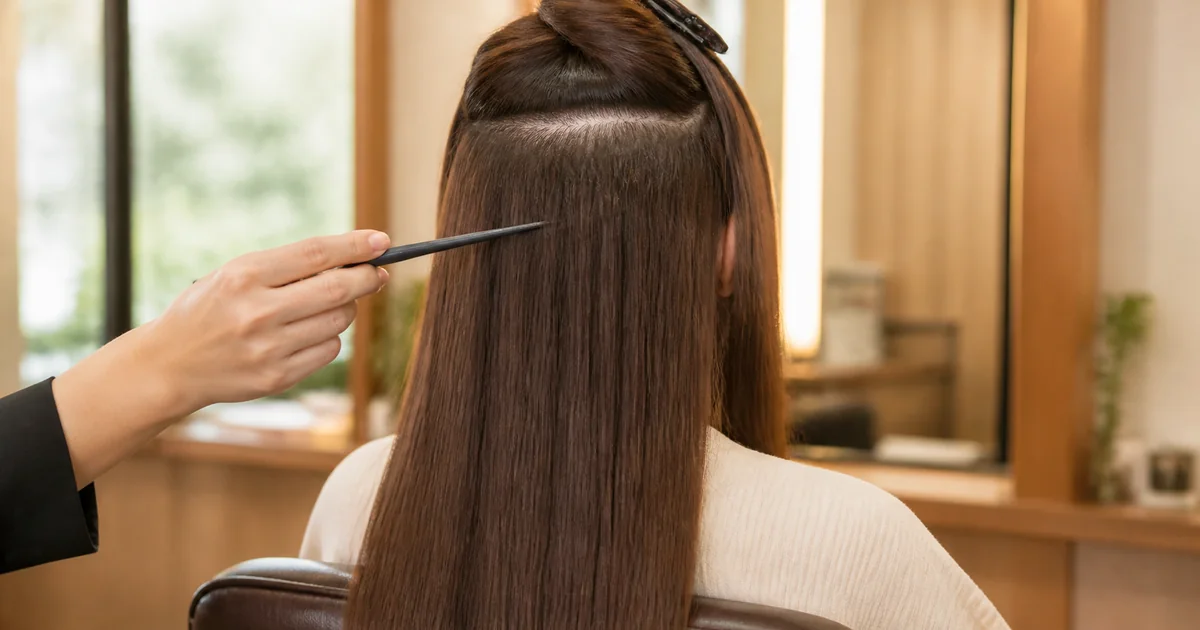
Illustrative scene, not an actual Faye client or a before-and-after comparison. It does not demonstrate a procedure, diagnose hair or scalp conditions, or guarantee results.
Separate treated lengths from new growth
YUKO’s system FAQ distinguishes treated lengths from natural new growth. This is a system example, not a claim that the salon uses that brand. Appearance changes also need assessment of condition, haircut, later services and styling; new growth is not the only possible reason.
How soon does the step become obvious?
There is no number that holds for everyone, because three things vary:
How fast your hair grows. Individual differences here are significant.
How strong your curl is. This has the biggest effect. With light curl, the difference between new growth and treated length is small and stays unobtrusive for a long time; with strong curl, the join shows quickly.
Your length. On short hair the step is proportionally more visible; on long hair there is enough weight and length below it that the join tends to get absorbed.
In practice people's intervals differ a lot. The way to judge it is not the calendar but how much time you are spending fighting your roots each morning. When drying no longer keeps that new growth down and you need a flat iron to leave the house, that is the point to come in for an assessment.
Assess roots, lengths and the boundary before a touch-up
Repeated chemical and heat processing adds stress, but breakage alone cannot identify its cause. Share the full history so the stylist can assess roots, lengths and their boundary before deciding whether, when and where to touch up. A return visit does not automatically justify reprocessing damaged ends.
What helps in between
Ask for sectioned drying and styling suited to your current hair, and record the areas that remain difficult. Follow tool and product instructions and avoid repeated high heat. Unstraightened roots are not automatically the healthiest hair, and drying cannot guarantee every boundary lies smooth.
Related reading and consultation: hair straightening aftercare.
When to come back sooner
For clear breakage or a local change, share recent photos and history for reassessment rather than requesting immediate reprocessing. Persistent scalp itching, pain, redness or broken skin needs medical assessment; another straightening service is not the answer.
If you are still deciding
For a first time, it is worth understanding how this differs from rebonding and which conditions call for waiting — see hair straightening vs rebonding and the Banqiao natural curl guide.
To discuss the right touch-up rhythm for your hair, send a few photos air-dried through Faye's LINE.
How long it lasts varies with growth rate, curl strength and length; the actual rhythm follows an in-person assessment.