Who Suits a Water Wave Perm? How the Pattern Forms, Length Needed and Upkeep
How a water wave perm creates continuous waves, the length it needs, how texture affects the result, and how to dry and maintain the pattern.
Water waves usually describe a continuous wave pattern, not one fixed formula or winding technique. Bring front, side and back references to discuss the pattern, starting point and dry length.
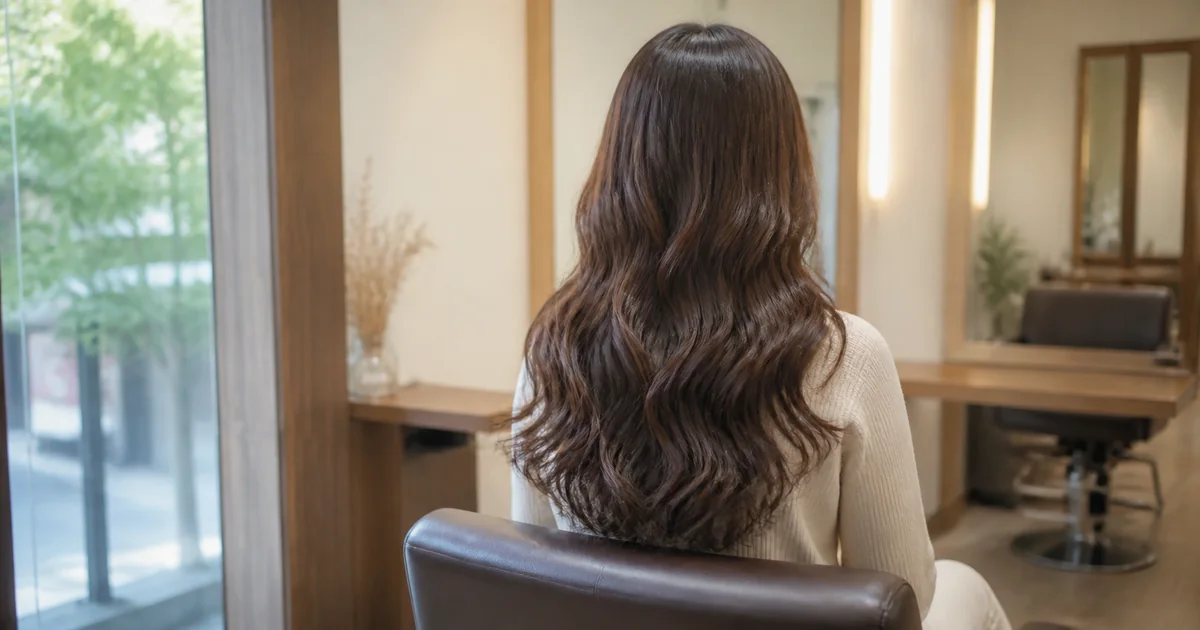
Illustrative scene, not an actual Faye client or a before-and-after comparison. It does not demonstrate a procedure, diagnose hair or scalp conditions, or guarantee results.
Where the pattern comes from
Point out continuous lines, loose bends or defined sections separately. A reference may include curling-iron or blow-dry styling, so a photo cannot establish one required sectioning or technique. Ask the stylist to assess the look and home routine for your hair.
How much length does it need?
Assess length together with wave size, starting point, layers and dry placement. There is no universal collarbone minimum or required number of bends. Show the shortest acceptable point on your own hair and any tying needs; discuss keeping length or another shape if the target is unsuitable.
Related reading and consultation: growing your hair out.
How texture changes the result
Diameter, density, natural curl and each area’s processing history all matter. Coarse or fine hair alone cannot predict the result or duration. Disclose bleaching, dark dye, straightening, local reprocessing and breakage. Assessment may lead to testing, a different goal or postponement; a smooth conditioned feel does not prove suitability.
How it differs from a large curl
Broad curls and water waves are reference names, not enough to rank styling difficulty or predict which stays attractive as it loosens. Identify the outline, wave starting point and pattern density, then discuss natural drying, blow-drying and products.
Keeping the pattern day to day
Blot gently rather than repeatedly rubbing or stretching the hair. Confirm sectioning and drying for the actual curl, products and tools, and ask for a routine you can reproduce. Note sleep creases and usual fixing habits without tight tying or extra high heat to preserve the pattern.
How long does it last?
Wear depends on condition, growth, cut, processing and daily styling. A perm name guarantees neither fixed months nor longer wear than another service. Record the dry outline and routine over time for reassessment. Trimming also changes length and curl presentation; it cannot guarantee preservation of the original pattern.
Related reading and consultation: types of perm and how to choose, perming fine, soft hair, Faye's LINE.
Perm results vary with hair texture, length and how the hair is styled; the actual outcome follows an in-person assessment.